Optium Museum Acrylic®
The virtually invisible acrylic that performs like glass and is trusted by the world’s most renowned museums is now available in four smaller, single-sheet sizes starting at 16×20 (405mm x 510mm) up to 32×40 (815 x 1015mm). Smaller sizes offer more framing choices at affordable price points to fulfill growing demand from the framing and design communities. These new sizes are now available through our worldwide network of authorized distributors.
Custom framers, learn more about our new, smaller, single-sheet sizes here.
-
99% UV Protection
-
Abrasion Resistance
-
Anti-Reflective
-
Anti-Static
-
Shatter Resistance & Safety
Size of 3MM Single Sheets
- 16″ X 20″
- 20″ X 24″
- 24″ X 32″
- 32″ X 40″
- 36″ X 48″
- 40″ X 60″
- 48″ X 96″
Custom Framing Project Size
- 16″ X 20″ and under
- 16″ X 21″ – 20″ X 24″
- 21″ X 24″ – 24″ X 32″
- 24″ X 33″ – 32″ X 40″
- 32″ X 41″ – 36″ X 48″
- 36″ X 49″ – 40″ X 60″
- 40″ X 61″ – 48″ X 96″
- With single sheets you buy
only what you need - Smaller sizes reduce need
for fabrication and offcuts - More economical than
purchasing a full box - Eliminates confusion
with easier pricing
Features
- Virtually eliminates reflections
- Blocks up to 99% of UV rays
- Optimal light transmission protects and brightens colors
- Anti-static protection that immediately dissipates static
- Durable hard coat protects against scratches
- Shatter resistance safeguards against injury and damage to artwork
- Cleans like glass – easy to clean with common household glass cleaners. No special acrylic cleaners needed.
- Proprietary coating is engineered for permanence
Applications
- Framing or display cases for cultural heritage and fine art collections
- High volume work – anti-static properties cut down on cleaning and fabrication time
- Static sensitive materials including textiles, charcoals, pastels, fragile surfaces, featherwork and lightweight papers
- Oversized works, structurally sensitive frames, and / or when glass is too heavy
- Irreplaceable works of art
- Shadowboxes for displaying objects, including family heirlooms or personal mementos
- Works that travel, high traffic areas, and public event spaces where safety is a concern
Individual Tests
- Passes Photographic Activity Test (PAT) ISO 18916
- Meets ISO 18902 section 3.9
- Surface Resistivity < 1.0E+12 Ohms/square tested by Fowler Associates at 73ºF for 48 hours at 100 volts
- Static Decay = 0.01 seconds per Federal Test Method Standard No. 101C, Test Method Number 4046
- Passes Oddy Test
- Passes Humidity Resistance MIL-C-48497A para 4.5.3.2
- Passes RoHS Compliance ASTM B117-03
- Passes Corrosion Resistance (Salt Fog) ASTM B117-03 & B368-03 & B368-97
- Passes Coating Adhesion (Snap Tape) MIL-C-48497A para 4.5.3.1
- Passes Solubility MIL-C-48497A
- Accelerated Aging 2000 hours (~100 years) of Q-sun Xenon Arc Testing at exposure intensity of 100,000 lux properties remain unchanged
Certifications
- Conservation Grade Protection
- ISO 18902 Photo Safe
- Safe for Friable Materials
Technical Info
Technical Info
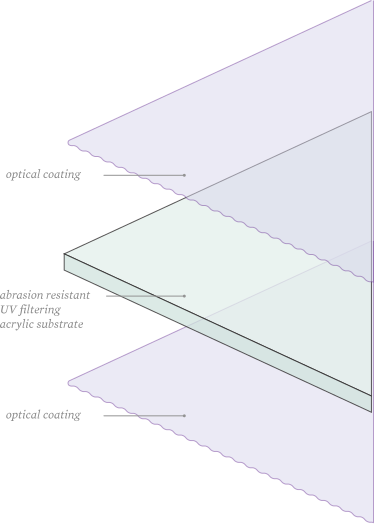
- Substrate: Abrasion Resistant UV Filter Acrylic
- Coating: Double-Sided Anti-Reflective
- Thickness: 3.0mm, 4.5mm and 6.0mm /.118″, .177″ and .237″
- Maximum Size: 72″ x 120″ / 1830mm x 3050mm
- Reflection: <1.6% (double sided)
- Transmission: >98% (total)
- UV Block: up to 99% of 300nm to 380nm UV rays
Resources
- High-Performance Acrylic and Glass Solutions (English)
- Acrylic Collection Fact Sheet (English)
- Acrylic Collection Fact Sheet (Chinese Simplified)
- Acrylic Collection Fact Sheet (Chinese Traditional)
- Acrylic Collection Fact Sheet (French)
- Acrylic Collection Fact Sheet (German)
- Acrylic Collection Fact Sheet (Italian)
- Acrylic Collection Fact Sheet (Japanese)
- Rijksmuseum Case Study (English)
- Rijksmuseum Case Study (Dutch)
- Rijksmuseum Case Study (French)
- Rijksmuseum Case Study (German)
- Rijksmuseum Case Study (Italian)
- Rijksmuseum Case Study (Portugeuse)
- Rijksmuseum Case Study (Russian)
- Optium Case Fabrication Guidelines (English)
- Optium Case Fabrication Guidelines (French)
- Optium Case Fabrication Guidelines (German)
- Optium Case Fabrication Guidelines (Italian)
- Optium Case Fabrication Guidelines (Spanish)
Care & Handling
Find out everything you need to know about Care & Handling for this product here.
GET More InfoFeatures & Benefits
Care & Handling